Calculate one layer, compare permitted orientations and add the height and weight limits. Build a packing record the next person can check.
For the example 1,200 × 800 mm footprint, rotated 400 × 300 mm cartons fit eight per layer. Five 250 mm layers plus a 150 mm base give 40 boxes at 1,400 mm total height.
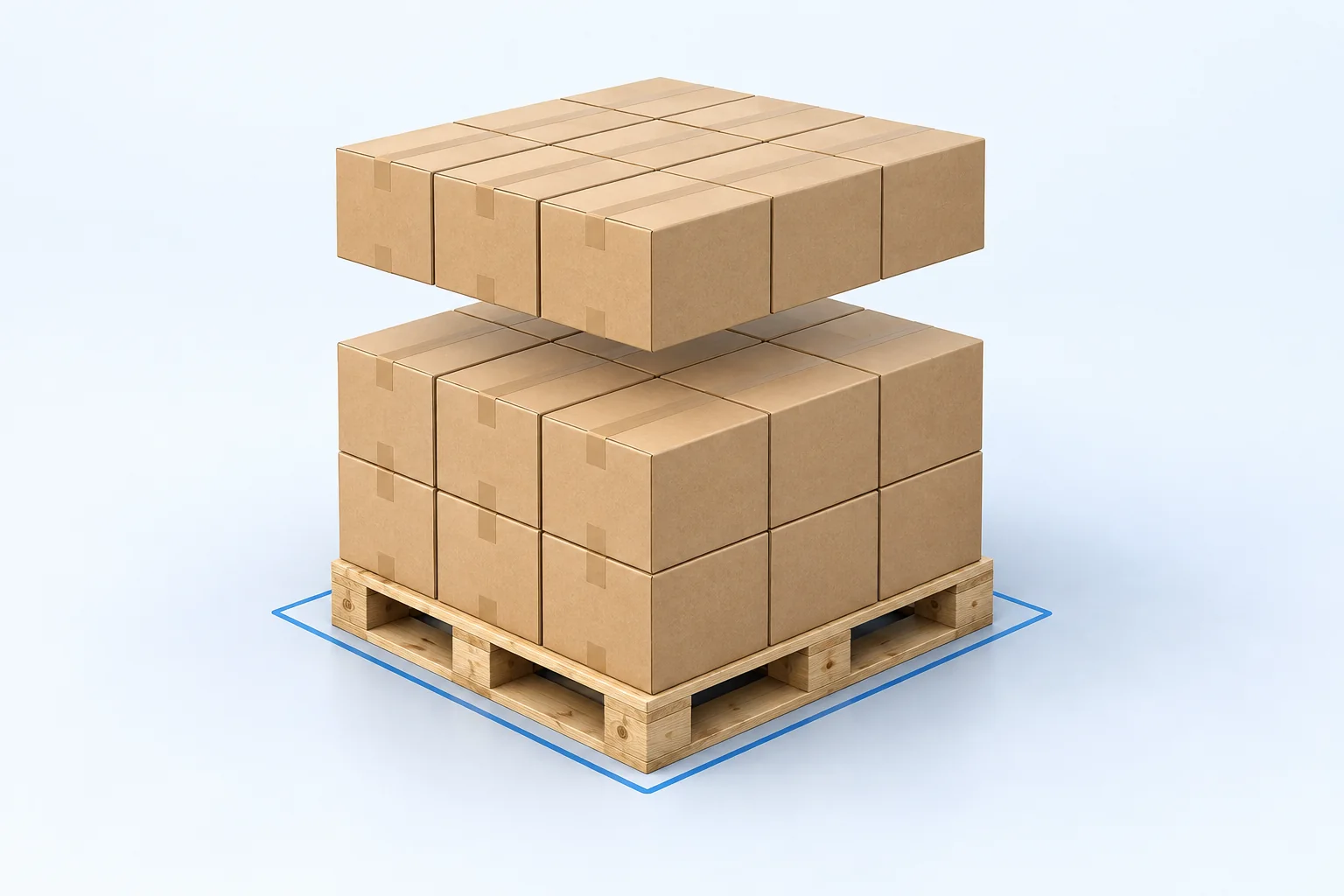
Plan one carton layer, then check the permitted number of layers. Conceptual illustration; the exact eight-carton layer is shown below.In this guide
To calculate boxes per pallet, first find a permitted arrangement on the pallet footprint. Then calculate how many layers fit within the height limit and check the weight and packaging restrictions. The lowest applicable limit controls the usable quantity.
For a simple uniform layer, divide pallet length by box length and pallet width by box width, round both results down to whole boxes and multiply. If in-plane rotation is permitted, repeat with the box length and width exchanged. Mixed patterns need their own placement check.
Collect the inputs that change the answer
Record the pallet’s usable length and width, the outside box dimensions, box quantity, gross box weight, pallet height and pallet tare weight. Obtain the maximum finished height and gross unit weight for this shipment, plus any restriction on layers, compression or orientation.
Distinguish turning a box on its base from tipping it onto another face. The first exchanges length and width while keeping height unchanged. The second changes the height and may violate an upright-only requirement. Do not treat every mathematical orientation as an allowed one.
A worked boxes-per-pallet example
Use these illustrative inputs: a 1,200 × 800 mm usable footprint, cartons measuring 400 × 300 × 250 mm, and a 150 mm high pallet. Assume in-plane rotation is allowed, there is no overhang and the maximum finished height for this example is 1,450 mm.
Compare two layer arrangements
With the 400 mm box side along the 1,200 mm pallet length, three boxes fit along and two across: 3 × 2 = 6 boxes per layer. The boxes occupy 1,200 × 600 mm, leaving a 200 mm strip across the remaining width.
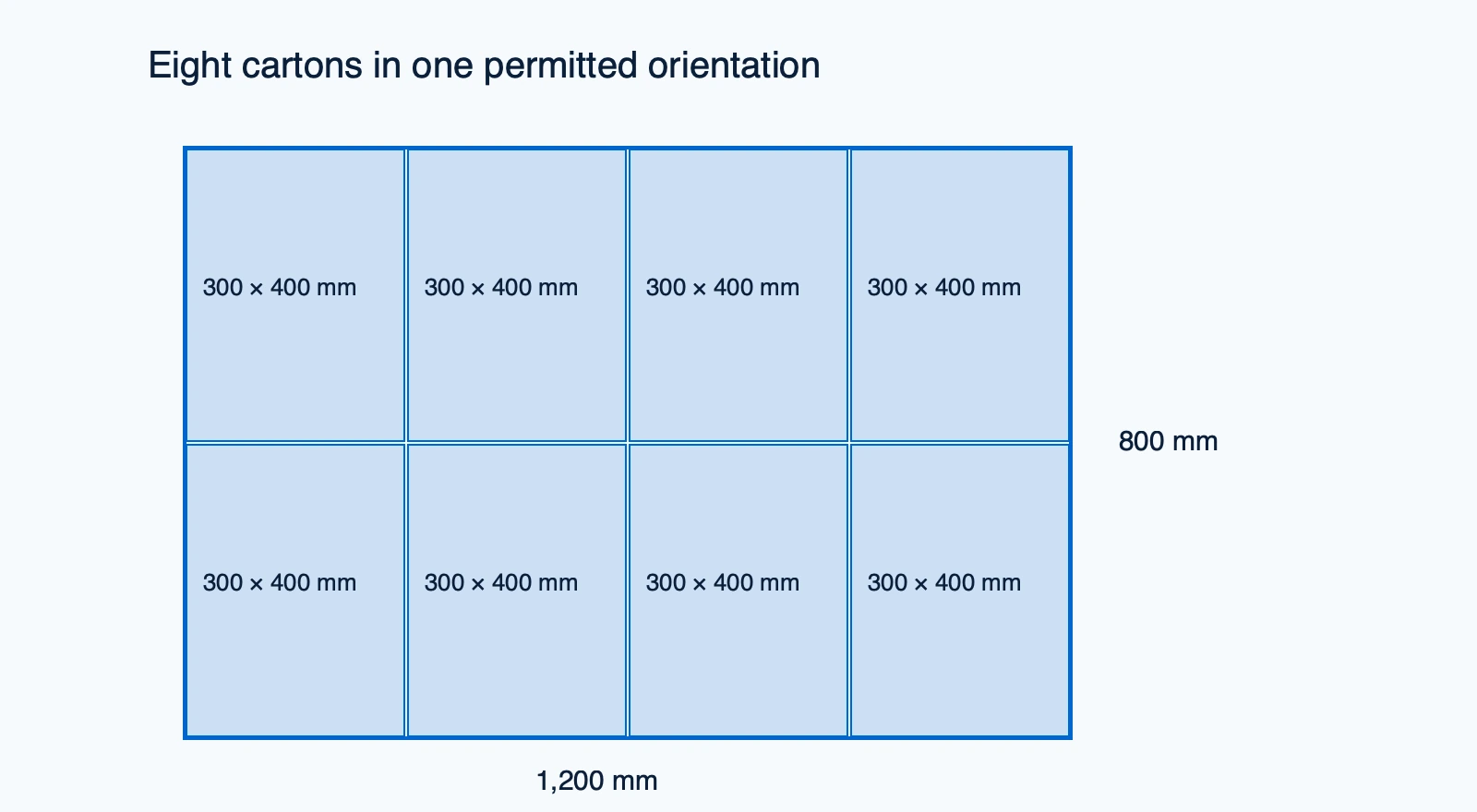
Turn each box so the 300 mm side runs along the pallet length. Four boxes fit along and two across: 4 × 2 = 8 boxes per layer. The arrangement uses the full 1,200 × 800 mm footprint in this idealised geometry.
Worked example – illustrative inputs
Layer arrangement
Along × across
Boxes per layer
Footprint coverage
400 mm side along pallet
3 × 2
6
75%
300 mm side along pallet
4 × 2
8
100%
The second layout reaches the area-based ceiling of eight boxes for these exact rectangular dimensions. That result assumes the measurements and no-clearance arrangement are usable in practice. Manufacturing tolerances, packaging bulges or required spacing can change the fit.
Add the height limit
Subtract the pallet height first: 1,450 − 150 = 1,300 mm available for cartons. Divide by the 250 mm carton height and round down: five complete layers fit geometrically.
At eight boxes per layer, the result is 40 boxes, with a finished height of 150 + 5 × 250 = 1,400 mm. A sixth layer would give 1,650 mm and exceed this example’s height limit. The unused 50 mm does not accommodate another complete layer.
Check weight separately
Assume each packed carton weighs 10 kg and the pallet tare is 25 kg. Forty cartons produce 40 × 10 + 25 = 425 kg gross. If the permitted gross weight for this illustrative unit is 500 kg, the arithmetic is within that limit.
That does not verify carton compression strength or pallet suitability. If the packaging specification permits only four layers, the candidate quantity falls to 8 × 4 = 32 boxes, even though the height and weight arithmetic would allow 40.
One layer contains 4 × 2 = 8 cartons. Five permitted layers give 40 boxes for the stated dimensions; the layer drawing does not approve packaging strength or stability.
Compare stacking patterns without assuming performance
Column stacking
In a column arrangement, cartons sit directly above corresponding cartons in the layer below. Keeping their load-bearing edges aligned can matter for corrugated packaging. The actual result depends on the carton, its contents and the support underneath; a neat column is not proof of transport stability.
Interlocking layers
Interlocking changes the arrangement between layers. It may help some rigid loads resist movement, but offsetting cartons can also change how loads are supported. Do not assume it is suitable for crushable goods or that it always improves strength. Confirm the packaging arrangement with the responsible supplier or packaging specialist.
Mixed box sizes
For mixed cartons, a single boxes-per-layer formula is insufficient. Plan each rectangle and record its permitted support and orientation. Avoid balancing small boxes over unsupported gaps. Compare complete candidate layers instead of adding separate “maximum” counts that compete for the same area.
Check the finished unit before planning the truck
Re-measure the load after packing. Include the base, top protection, wrapping and any change in footprint. The final gross weight and outside dimensions become inputs for the vehicle or container plan.
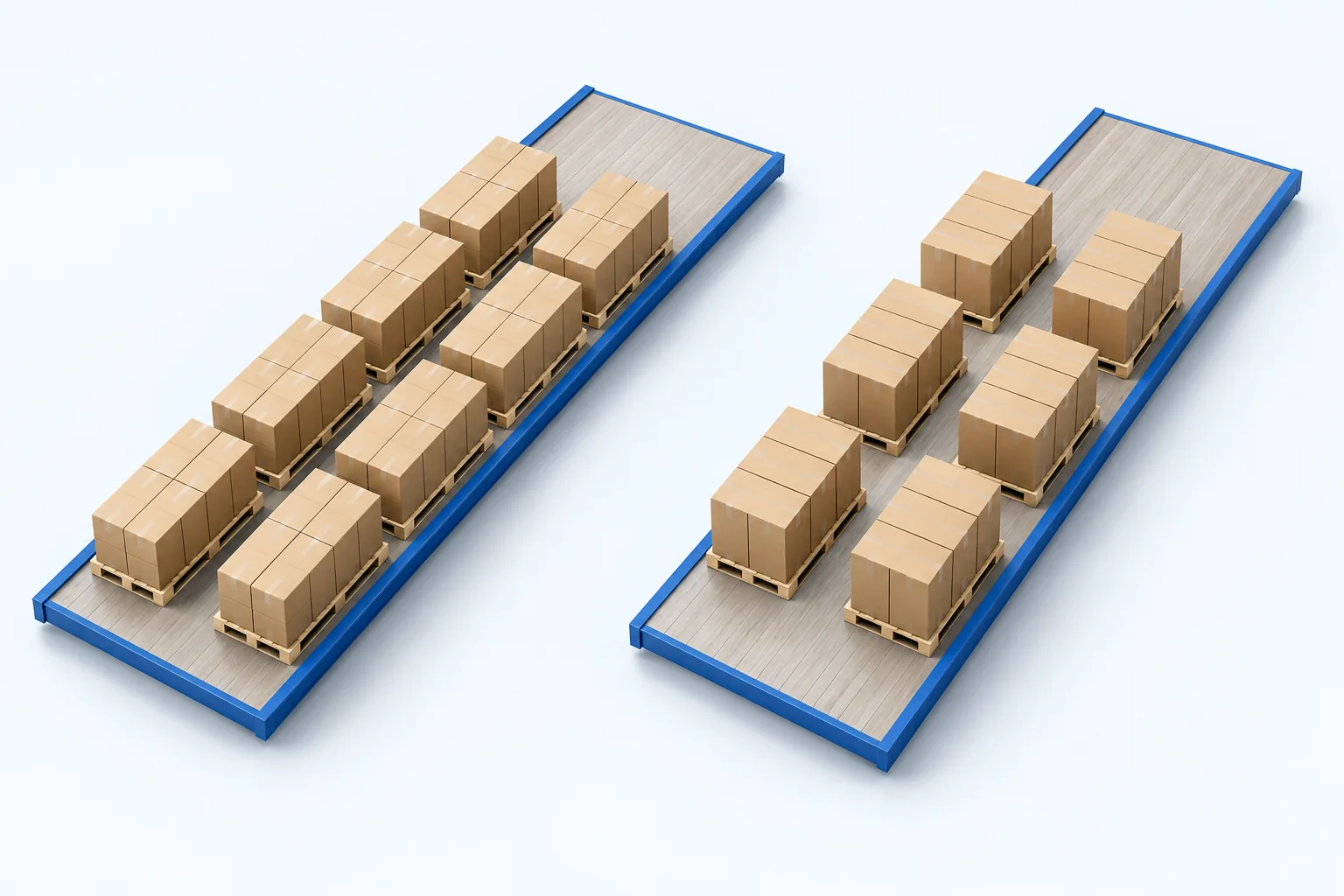
Keep carton placement on a pallet separate from loaded pallet placement on a vehicle floor. Turning a loaded pallet changes its position in the truck, not the number of cartons already packed on it. See the pallet loading patterns guide for that next step.
Record the approved configuration
Keep the carton and pallet specifications, a layer drawing, boxes per layer, number of layers and finished dimensions together. Record how the unit is protected and secured under your operating procedure. Do not substitute a generic number of wrap turns for a packaging specification.
For the example above, the geometric record is eight boxes per layer, five layers and 40 boxes at 1,400 mm total height. The operational record must additionally confirm that the packaging permits those five layers and that the complete unit can be handled as intended.
Plan pallet placement in CargoTetris
CargoTetris supports geometric planning for pallets and loading spaces with 3D visualisation. Use the checked cargo dimensions and the chosen pallet space to review placement, then use the finished loaded-unit dimensions when planning transport.
Start with one repeatable shipment configuration. Reconcile the planned quantity with the packing list and inspect the arrangement before release. A count becomes useful when the team can reproduce the same input, layout and restrictions.
Choose the pallet spaceUse the actual usable footprint and the permitted load height.
Add the packed cartonsEnter dimensions, quantities and weights, or import a cargo list.
Set the permitted rulesApply the allowed rotations and stacking constraints for the goods.
Review the finished arrangementReconcile the quantity and verify packaging limits before planning the loaded pallet in transport.
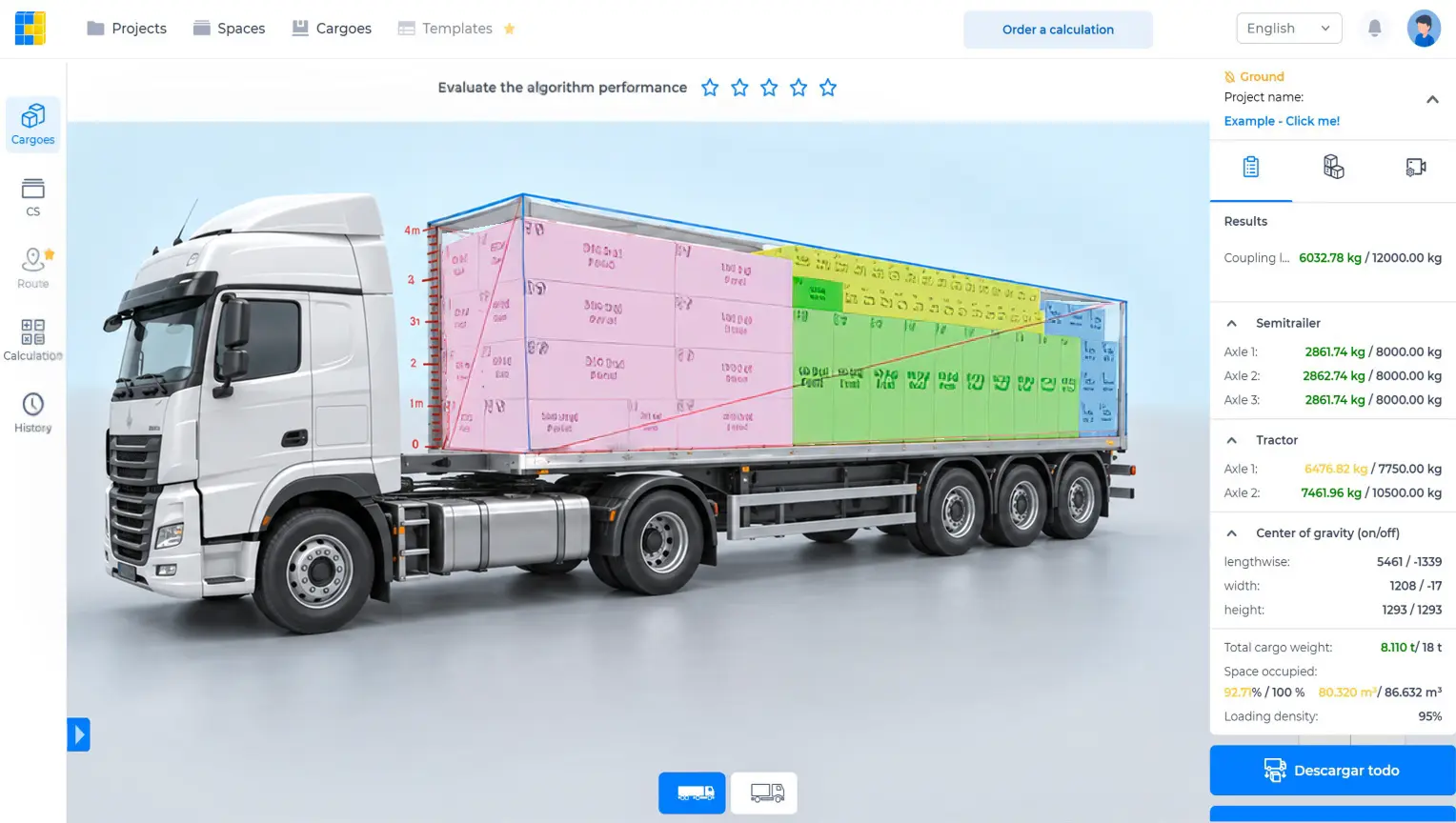
Actual CargoTetris interface from the product website. The screen shows a separate demonstration load, not the numerical example in this guide.
Watch the CargoTetris workflow
See the English product walkthrough, from cargo data to loading instructions. Duration: 7:52.
Pallet stacking questions
Can rotating boxes increase the count?
Yes, for some dimensions and permitted orientations. In this example it changes a uniform layer from six to eight boxes. Other dimensions can produce the same count or a lower count.
How high can I stack a pallet?
Use the limits for the packaging, pallet, handling equipment, customer and transport arrangement. There is no single height that this calculation can approve for every shipment.
Does 100% footprint coverage mean the pallet is ready to ship?
No. It describes an area calculation. Height, gross weight, support, compression, stability, handling and securing still need to satisfy the requirements of the actual load.
Plan carton placement on your pallet
Create your CargoTetris account, add the checked cargo dimensions and choose a pallet loading space. Review the arrangement in 3D.
So — you’ve got a shipment. Pallets, boxes, crates, whatever. It needs to be stacked. The question is: how? Column or block? Vertical or staggered. Straight like a Lego tower or offset like bricks on a wall? Sounds like a simple choice. It’s not. The way you stack your goods can be the difference between a clean, efficient load — and a forklift operator muttering expletives as boxes rain from the top tier. Let’s break it down.
Compare the same cargo on the same usable floor. See how orientation changes the number of positions, remaining space and questions to check before loading.