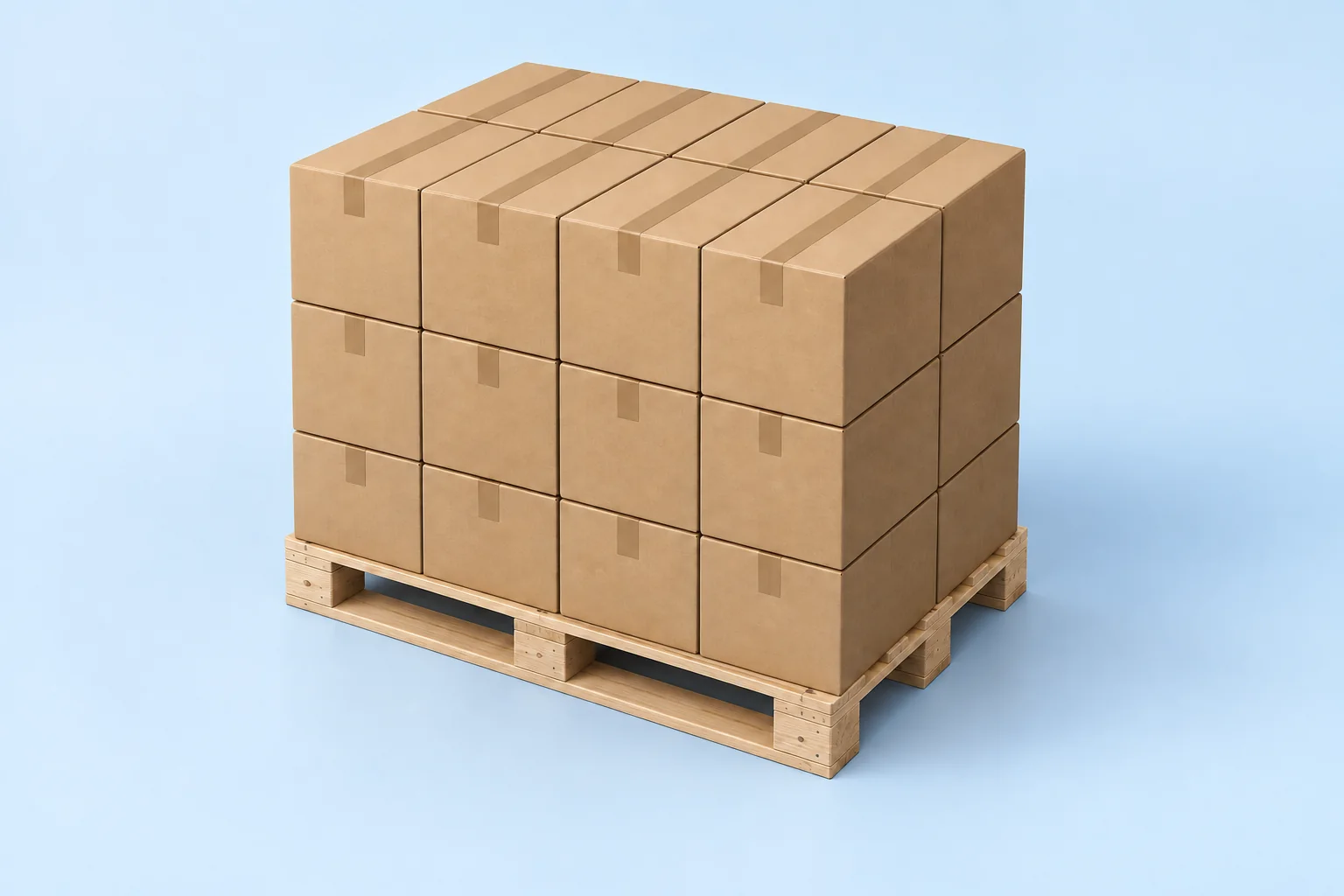
Pallet loading patterns: a 53-foot trailer example


Compare the same cargo on the same usable floor. See how orientation changes the number of positions, remaining space and questions to check before loading.
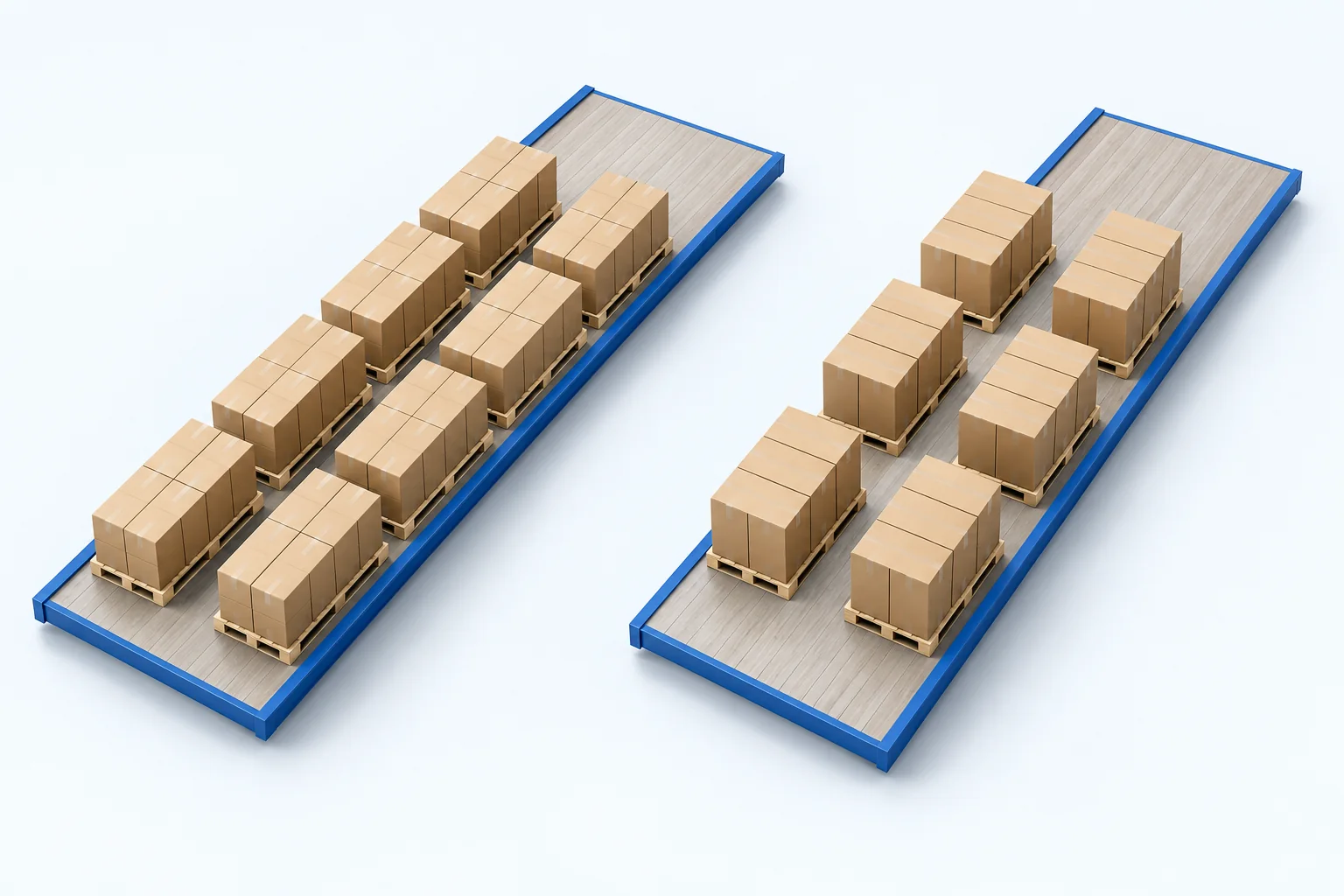
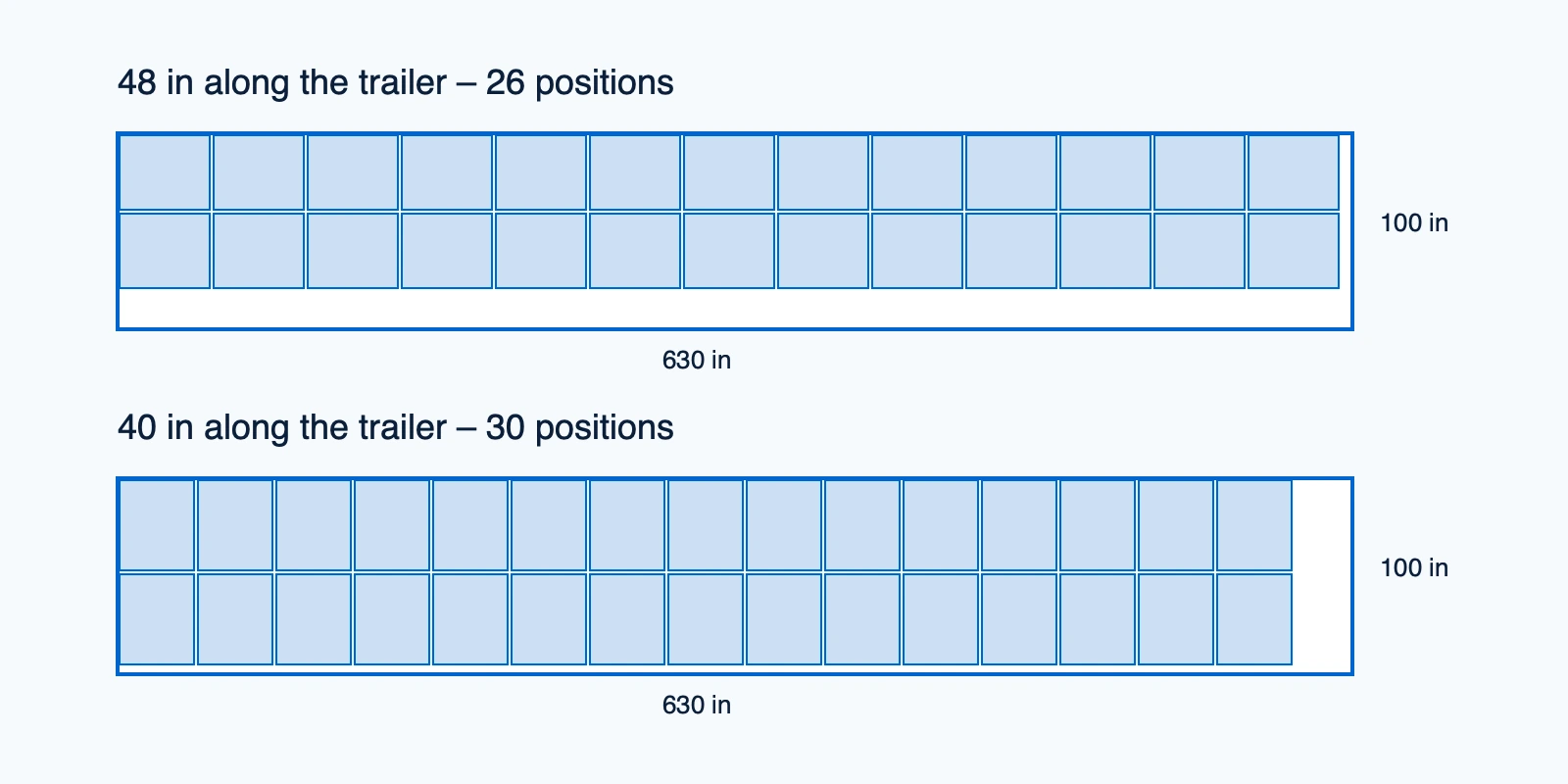
On an illustrative 630 × 100 in floor, 48 × 40 in pallets form 26 or 30 positions in two uniform orientations. These are geometric layouts, not confirmed transport capacities.
In this guide
Choose a loading pattern you can reproduce
A pallet loading pattern describes how complete loaded pallets are arranged on a vehicle or container floor. Start with the measured shipping units and usable floor, then compare orientations under the same assumptions.
The useful output is more than a pallet count. It should show which way each unit faces, the space remaining around it and any access the loading operation needs. A layout that fits on a drawing still requires separate weight, handling and cargo-securing checks.
Define what “straight” means in your plan
Names such as straight, turned and pinwheel can be used differently across teams. Label the pallet dimension running along the vehicle. For a 48 × 40 in unit, write “48 in along the trailer” or “40 in along the trailer” instead of relying on a pattern name alone.
Measure the complete loaded footprint. Cartons, wrapping and overhang can make it larger than the empty pallet. If rotation is prohibited by the goods or handling method, that orientation is not an available option.
Compare two orientations in a 53-foot trailer example
For this illustrative calculation, use a 630 × 100 in usable floor and loaded pallets with a 48 × 40 in footprint. Use one level, identical units and no overhang. The inputs do not describe every 53-foot trailer, and the results are not a CargoTetris performance test.
Put the 48 in side along the trailer
Thirteen complete rows fit along the length: 13 × 48 = 624 in. Two pallets fit across the width: 2 × 40 = 80 in. The result is 26 pallet positions, with a total geometric remainder of 6 in in length and 20 in in width.
Turn the pallets so the 40 in side runs along the trailer
Fifteen complete rows now use 15 × 40 = 600 in. Two pallets across use 2 × 48 = 96 in. This arrangement gives 30 positions, leaving 30 in in length and 4 in in width in total.
| Uniform arrangement | Positions | Length left | Width left | Floor coverage |
|---|---|---|---|---|
| 48 in side along trailer | 26 | 6 in | 20 in | 79.2% |
| 40 in side along trailer | 30 | 30 in | 4 in | 91.4% |
The second arrangement has four more positions in this simplified comparison. That does not establish four additional shippable pallets. The narrower remaining width may be insufficient for the actual handling method, and weight or other restrictions may prevent using all positions.
Floor coverage here means total pallet footprint divided by 630 × 100 in. It is not a claim about vehicle payload, shipping cost or the globally optimal arrangement.
Understand when a mixed pattern needs more detail
Compare the actual rectangles
A mixed pattern uses more than one orientation in the same load. It can change where unusable gaps occur, but it should be drawn and counted explicitly. A name such as pinwheel does not prove a higher capacity for your dimensions.
For each proposed arrangement, record the number of complete units and the dimensions consumed by every row or block. Check that blocks do not overlap and that no unit extends outside the usable space. Keep rotation rules identical between comparisons.
Distinguish pallet placement from carton stacking
Turning complete pallets on a trailer floor is a different decision from arranging cartons in layers on a pallet. The latter involves carton support and packaging restrictions. Use the pallet stacking guide for that separate calculation.
Check more than the largest count
Loading and unloading access
Review how the first and last units will be handled. A multi-stop shipment may need particular goods accessible at an earlier stop. Record those requirements before comparing layouts; otherwise a dense arrangement can create extra handling later.
Weight and distribution
Collect gross weights for complete loaded units. This article’s example contains no weight inputs, so it cannot produce a payload or axle-load result. A plan with more geometric positions can still exceed a weight limit or distribute the load incorrectly.
Securing and working space
The remaining inches in the table are geometric differences, not approved securing gaps. The actual loading method may require space for protection, restraint or equipment. Have the responsible operator include those requirements in the usable-space definition.
Make a loading plan the next shift can use
Keep the equipment ID, measured interior, cargo list and assumptions with the drawing. Give each cargo type a recognisable name. Show orientation clearly and document any permitted exceptions rather than expecting another person to infer them from the picture.
Before release, reconcile the planned quantity with the packing list. If only part of the shipment fits, identify the unplaced units explicitly. Do not describe an arrangement as complete just because the visible cargo looks orderly.
Review your arrangement in CargoTetris
CargoTetris lets you work with cargo placement in 3D for trucks, containers and pallets. Prepare the actual loaded dimensions and quantities, choose the loading space and inspect where each group of units is placed.
Use the article’s arithmetic as a check on a simple uniform layout. For your own shipment, compare the resulting arrangement with the same input list and operational requirements. A reproducible comparison begins with the same cargo, equipment and rules.
- Enter the loaded palletsUse complete outside dimensions, quantities and gross weights.
- Define the actual trailerUse measured cargo-space dimensions rather than its nominal length.
- Keep the rules consistentApply the same cargo orientations and stacking restrictions when comparing plans.
- Inspect the resultCheck the placed count and loading sequence, then prepare the plan for your team.
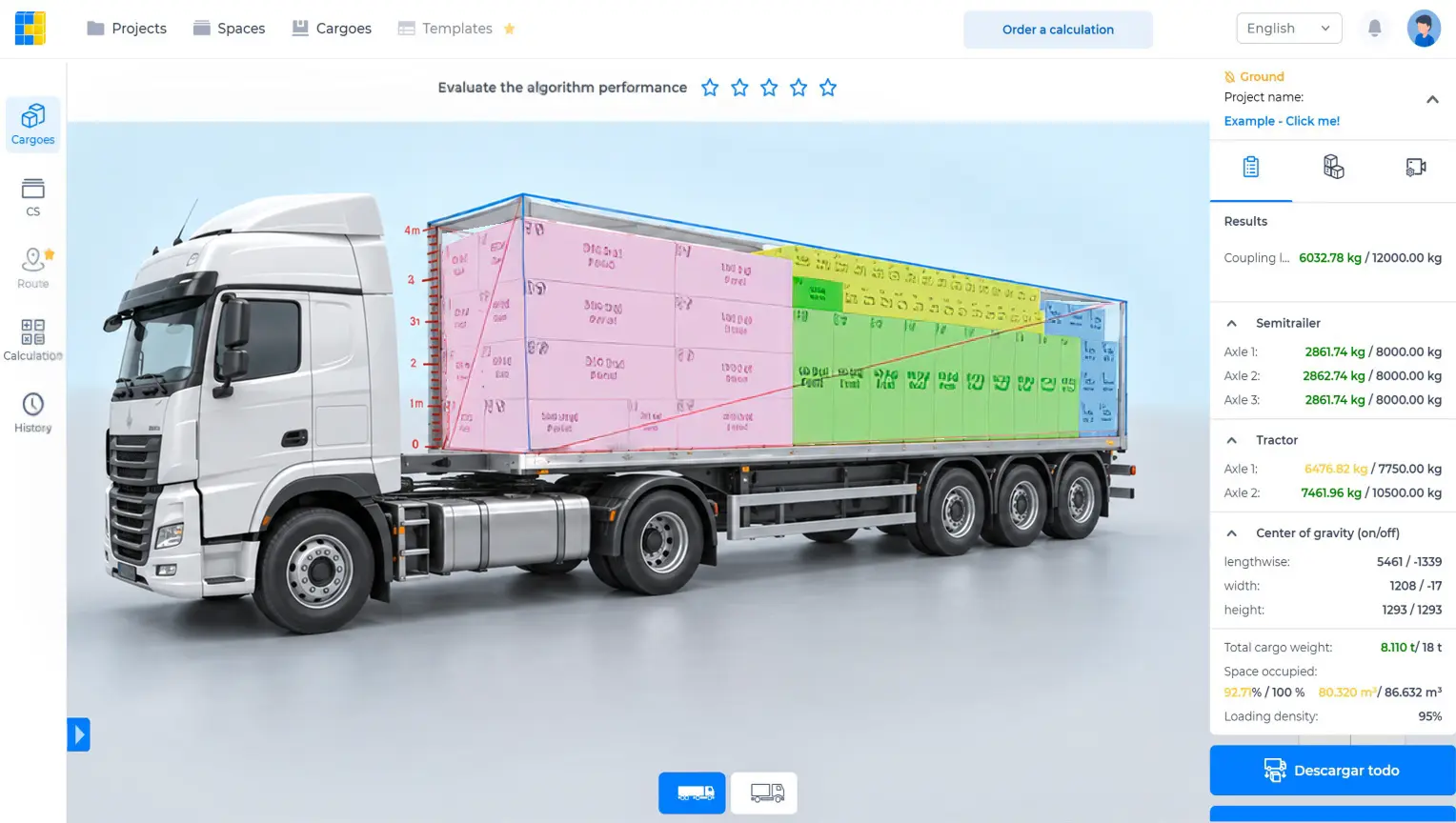
Watch the CargoTetris workflow
See the English product walkthrough, from cargo data to loading instructions. Duration: 7:52.

Pallet loading pattern questions
How many pallets fit in a 53-foot trailer?
There is no single answer without the usable interior, finished pallet dimensions, permitted orientation and other constraints. This example gives 26 or 30 positions for two specific uniform arrangements; it does not define every trailer’s capacity.
Is turning pallets always better?
No. It can increase or decrease the count depending on the dimensions, and the goods or handling method may prohibit it. Compare both permitted orientations using complete rows.
Does the pattern with the highest count save the most money?
Not necessarily. A cost comparison also needs actual transport prices, handling time, payload and any packaging changes. A higher geometric count is one input to that decision.
Review your own pallet loading pattern
Create your account and plan with your actual loaded pallet dimensions. Use CargoTetris to inspect a 3D arrangement of your shipment.
Continue to complete registration in the app.
Leia também