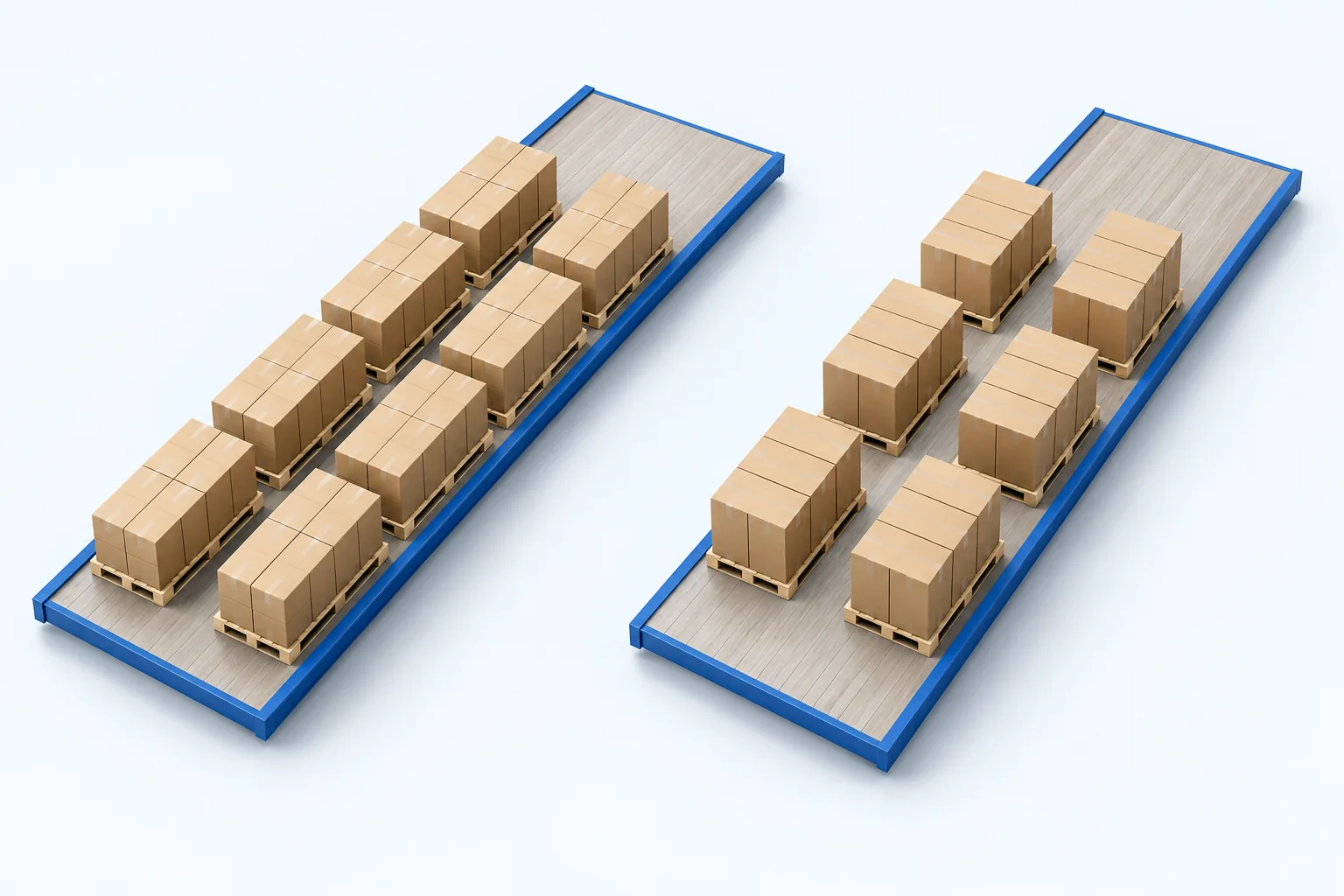
Construction material load planning with axle and stacking constraints


Construction materials can combine several load-planning difficulties. A trailer may carry dense palletized goods, fragile insulation, long profiles and bagged material, each with its own stacking limit. Both total weight and its distribution need attention.

In this guide
Dense goods reach the weight limit first
Dense goods such as tiles or bagged mortar may reach a vehicle's weight limit before filling the available space. After checking the total, review where that weight is placed rather than treating the remaining volume as spare payload.
With dense goods, concentrating cargo at one end can overload an axle even when the total is within the configured limit. Check the actual vehicle ratings and applicable requirements for the route. There is no single gross or axle limit that applies to every vehicle configuration and journey.
| Shipping units | Count | Gross unit weight | Line weight |
|---|---|---|---|
| Dense loaded pallets | 4 | 800 kg | 3200 kg |
| Light loaded pallets | 8 | 100 kg | 800 kg |
| Total | 12 | Different weights | 4000 kg |
The total is 4 × 800 + 8 × 100 = 4000 kg. This example does not establish axle loads, fit or a permitted stacking arrangement.
Light goods reach the volume limit first
Insulation is the opposite case. It fills a trailer at a fraction of the weight limit, and the planning question becomes how to combine it with something dense so neither vehicle travels half-used.
Mixed loads of dense and light material are efficient on paper and easy to get wrong in practice, because the heavy items must be positioned for axle balance while the light items fill what is left without being crushed.
Stacking limits are product properties
Insulation, panels and bagged products can have different stacking, crushing and support limits. Use the packaging specification for the particular goods. A suitable geometric arrangement still requires the loading team to verify support, stability and cargo securing.
Support and stacking limits differ between materials and packaging constructions. Use the approved limits for each item; the load plan does not by itself establish resistance to crushing or tipping.
Long items in a mixed load
Profiles, pipes and panels can occupy much of the deck length and leave irregular spaces around them. They also carry restrictions on orientation and support. Model the complete shipping units together with the pallets so that the plan reflects what the crew will handle.
What the plan checks
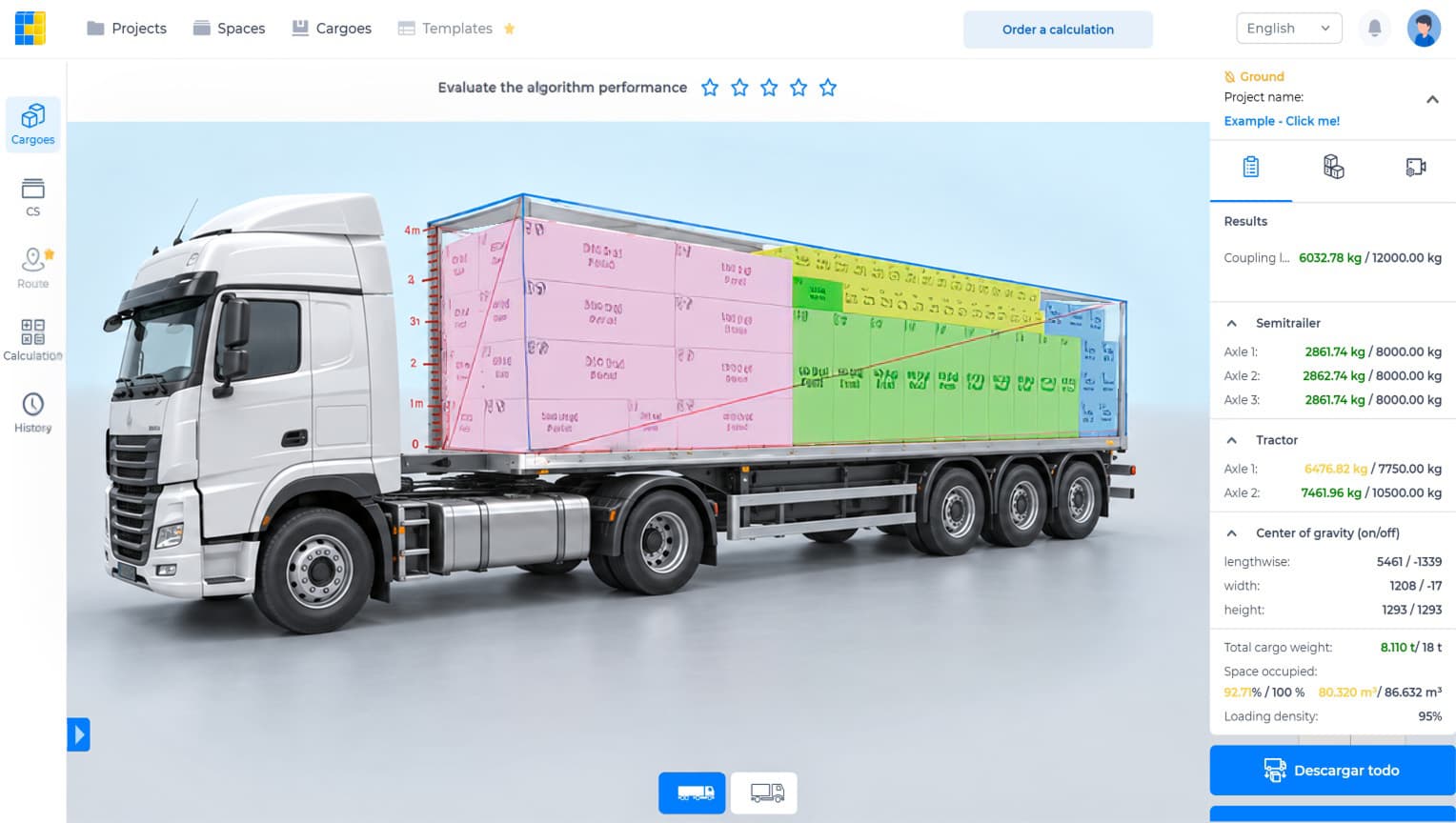
For a tractor and semi-trailer the results panel reports the load on each semi-trailer axle against its limit, the load on each tractor axle against its limit, the coupling load against its limit, the centre of gravity lengthwise, across the width and in height, total cargo weight against the vehicle limit, space occupied as a percentage and in cubic metres, and loading density.
For a shipment that is at its weight limit with the trailer half empty, those axle figures are the entire plan. The worked example in the truck loading guide shows how far apart the numbers can sit: a load at 45% of its total weight limit with one axle at 84% of its own. They are also editable in practice – move a pallet in the 3D scene, recalculate, and see the axle reading change.
Order preparation
Group goods by delivery point and check the loading sequence against access at each stop. The sequence can reduce unnecessary handling, but its effect on time and cost should be measured on your own routes.
CargoTetris provides PDF and Excel reports and a step-by-step loading view. Keep the final approved cargo list and instructions with the shipment record.
Related case studies
The CargoTetris website describes tailored implementations for these manufacturers. Their product-specific workflows are references for discussion, not proof that every feature or result is included in a standard account:
Saint-Gobain: Read the case
ROCKWOOL: Read the case
REHAU Group: Read the case
Watch the CargoTetris workflow
See the English product walkthrough, from cargo data to loading instructions. Duration: 7:52.

Start with your own cargo list
Create an account, enter a representative shipment and review the available planning workflow with your team.
Continue to complete registration in the app.
Read also