






ENTERPRISE

A load planning API that runs inside your systems, on your rules, at your scale

When load planning stops being one person with a screen and becomes part of how the company ships, we build that part with you. The order comes from your ERP, WMS or TMS, the load plan goes back into it, and nobody touches a spreadsheet.

Who Enterprise is for

Four situations where the plans on our pricing page stop being enough.

Companies running an ERP, a WMS or a TMS

SAP, Oracle, Dynamics, or whatever else your orders live in. The order already exists there, and someone re-types it into a load planner by hand. Enterprise connects the two: the order comes from your system, the plan goes back into it.
Manufacturers and distributors

Long, heavy or fragile goods, with rules nobody ever wrote down: stacking limits by SKU, temperature zones, hazardous goods, customer-specific requirements. We put those rules into the algorithm.

Hubs and consolidation warehouses

One shipment carries several orders for several receivers, so the loading order decides the unloading order. The warehouse gets the instruction in your own format, not ours.

Forwarders and carriers

Mixed and non-standard cargo by road, rail, sea and air, where more than ten people across sites and shifts have to apply the same rules the same way every time.

Load planning API

Your systems already know what you ship. Our load planning API plugs into them.

No more manual data entry. The order data your ERP, WMS or TMS already holds comes across, the plan is calculated against your rules, and the result goes back where your team already works.

From your systems

01

Your ERP, TMS or WMS has the order data: dimensions, weights, packaging, destinations and delivery sequence. It sends that across, together with the vehicles available for the shipment.

CargoTetris

02

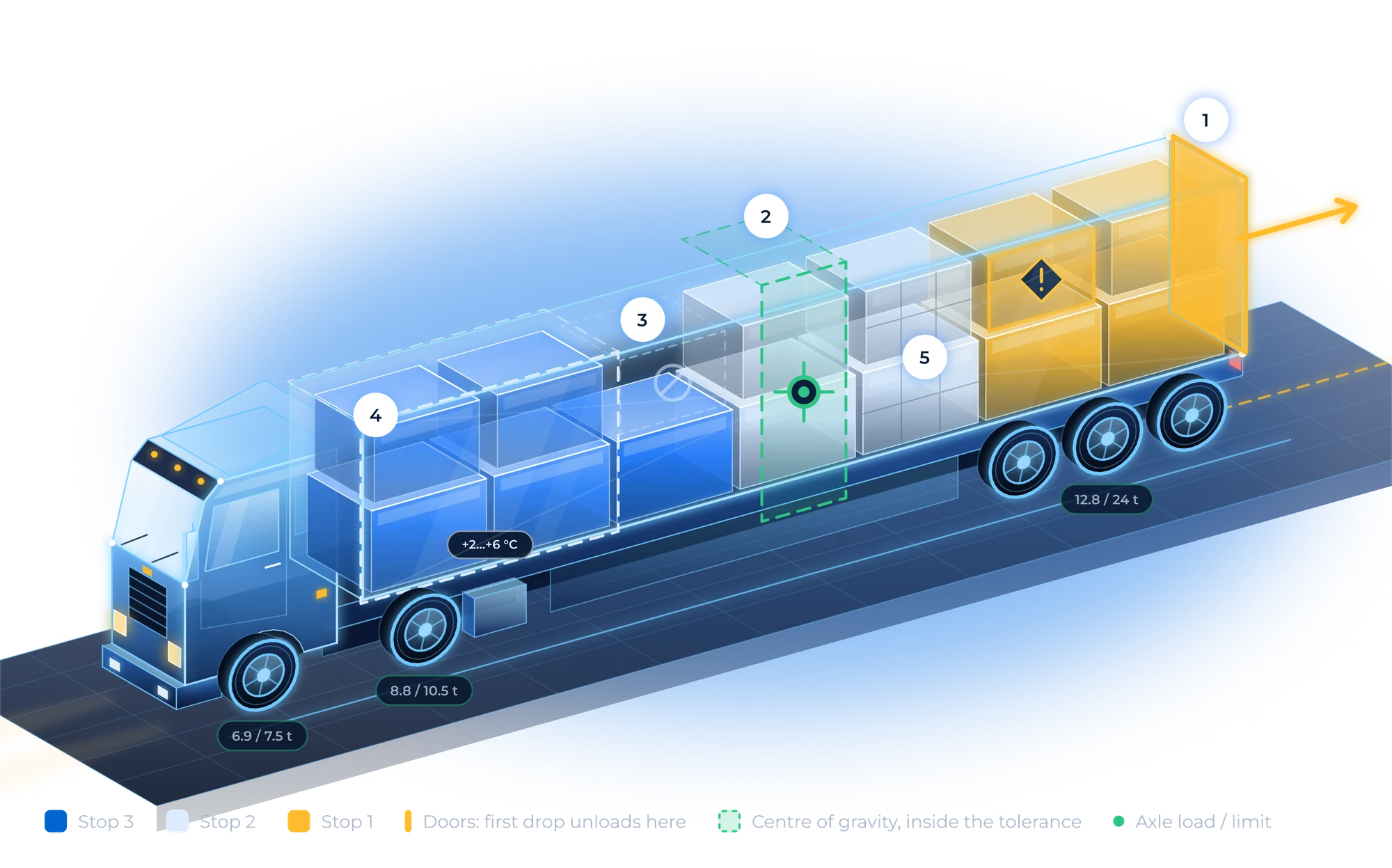
The algorithm builds the plan against your rules, checks axle loads and weight distribution, respects stacking limits and the unloading order, and produces the 3D layout.

Back to your systems

03

How many vehicles the shipment really needs and what did not fit, fill rate by volume and by weight, axle loads with a pass or fail, the loading documents, and a link to the interactive 3D plan.

One shipment, end to end.

Your system
CargoTetris
Your warehouse

Shipment, items, vehicles, constraints

Plan built and checked against your rules

Plan, fill rate, axle check, what did not fit

Loading instruction in your own format

  1. 1

    Your system → CargoTetris

    Shipment, items, vehicles, constraints

  2. 2

    CargoTetris

    Plan built and checked against your rules

  3. 3

    CargoTetris → Your system

    Plan, fill rate, axle check, what did not fit

  4. 4

    Your system → Your warehouse

    Loading instruction in your own format

Three ways to make the connection.

The load planning API

A JSON API: your system triggers a calculation and reads back the plan, the summary and the documents. The fastest route when your team can open an outbound connection.

Through your integration layer

Most large landscapes already have one. We sit behind it like any other service, and your rules about what may leave the perimeter stay in force.

File exchange on a schedule

When the API is closed to us, we read the export your system already produces and write the plan back the same way. Nothing changes inside your system.

Your data, and what happens if you leave

Procurement asks this before the security questionnaire does, so here it is in plain words rather than in an annex.

It is yours

Your shipments, your item master and every plan calculated from them stay your property. Nothing you send us is shared with anyone else.

You can take it out at any time

Shipments, your vehicle library and the calculation history, exported without asking us for permission.

The rules we write down stay with you

During the analysis we write down the loading rules your people follow, which in most companies exist only in somebody's head. That document is yours, and it is worth having whatever happens next.

On-premise and private cloud

The question mostly answers itself: the data never leaves your infrastructure in the first place, and the instance keeps running whatever happens between us.

Not sure what your systems can do?

Send us a sample export and your integration constraints. Our team will look at your documentation and tell you which of the three routes fits, before anyone signs anything.

And then it just runs

Once the connection is in place, nobody on your side goes looking for a planning tool. Each role gets what it needs where it already works.

The planner

Opens a shipment that is already filled in from your system, changes what needs changing, and runs the calculation. The plan goes back by itself. No export, no re-typing, no second tool to keep in sync.

The warehouse

Gets the loading instruction in your own format, on paper or on a tablet at the dock, with the sequence step by step. The yard loads to the plan instead of improvising, and the driver signs for a vehicle that is within its limits.

The manager

Sees fill rate and the number of vehicles per shipment in the system they already report from. Every calculation stays in the history, so a plan that worked can be found and repeated rather than reinvented.

What the algorithm actually checks

This is the part a spreadsheet cannot do, and the reason a plan made by hand costs you a vehicle or a fine.

Two things, and you can take one or both

One is a subscription on enterprise terms. The other is a project that changes the product to fit how you work. Most companies start with the first and add the second.

Enterprise plan

The product you already know, on enterprise terms.

  • Unlimited or agreed number of users
  • Private cloud or your own infrastructure
  • A named contact and agreed response times
  • Contract and invoicing, not a card payment

Custom development

The product changed to fit how you work.

  • Integration with SAP, an ERP, a WMS or a TMS
  • Your loading rules built into the algorithm
  • Your loading instructions, reports and packing lists
  • Data migration from what you use today

Under your brand, if that is what you need

Some companies want their planners to see CargoTetris. Others want nobody to see it at all. Three levels, and you pick how far to go.

Level 1

Your documents

Loading instructions, packing lists and reports in your layout, with your logo, in the languages your sites work in. The warehouse never sees a document that looks foreign.

Level 2

Your look inside the product

Your colours, your logo and your own domain, so planners work in something that belongs with the rest of your tools instead of a third-party site.

Level 3

Inside your own product

Your customers plan loads without leaving your portal. The calculation runs behind your interface and CargoTetris is never named to them.

Where your data lives is your decision

Cloud

Hosted and kept running by us. Nothing to install, nothing for your team to maintain.

Private cloud

A dedicated instance inside your own cloud account, so the data never leaves your tenancy.

On-premise

Installed inside your own network, behind your firewall, for companies whose data cannot leave it.

How a project runs

Nothing is built before you have the scope, the price and the timeline in writing.

  1. Analysis

    Kickoff, requirements, and the loading rules your people follow today written down for the first time.

  2. Scope

    What is possible, what is not, what it costs and how long it takes. In writing, before anything is built. If we cannot build it well, we say so here and not three months later.

  3. Build and connect

    Algorithm rules, documents, and the connection to your systems, tested on your own historical shipments.

  4. Onboarding

    Your planners and warehouse team start working in the system with us, before it goes live.

  5. Go live and support

    Switching over, then changes to the system as your processes change.

What it changed

  • Electronics
  • Home appliances
100% less damage from incompatible placement
+20% loading efficiency

Challenge

Hisense processes 50–70 truck and container loads per day. Shipment data from multiple distributors arrived in different formats, while every load plan had to follow compatibility rules for different appliance categories. The differences in source data slowed down transport planning and increased the risk of loading errors.

Implementation: 3 months

  • Electronics
  • Home appliances
100% less damage from incompatible placement
+20% loading efficiency

With CargoTetris

CargoTetris was adapted to Hisense's transport planning rules and product compatibility requirements. Shipment data from distributors was converted into a standardized format, and the system was integrated with the company's IT infrastructure. CargoTetris generated load plans according to a single set of rules and transferred the calculation results to connected systems.

Implementation: 3 months

  • Home appliances
  • HVAC
100% less damage from incompatible placement
+12% loading efficiency

Challenge

Midea needed to automate vehicle loading for different appliance categories. Each load plan had to comply with compatibility rules between product groups, prevent damaging combinations and take routing requirements into account.

Implementation: 4 months

  • Home appliances
  • HVAC
100% less damage from incompatible placement
+12% loading efficiency

With CargoTetris

CargoTetris was configured with custom compatibility and placement algorithms for different appliance categories. During calculation, the system excluded prohibited combinations and selected a suitable position for each item. API integration with ERP and WMS automated the exchange of shipment data and load plans. Routing requirements were included when forming each load.

Implementation: 4 months

  • Building materials
  • Order planning
15% less damage from incompatible placement
+6% loading efficiency

Challenge

Saint-Gobain needed to optimize the loading of different construction materials during order formation. Each load had to maintain balanced weight distribution, comply with axle load limits and use available vehicle capacity.

Implementation: 5 months

  • Building materials
  • Order planning
15% less damage from incompatible placement
+6% loading efficiency

With CargoTetris

CargoTetris was configured with loading algorithms for different material categories and integrated into the company's ordering system. As products were added to an order, the system calculated their placement, weight distribution, axle loads and remaining vehicle capacity. Distributors could see which additional products could be included while maintaining a feasible load plan.

Implementation: 5 months

  • Wood-based materials
  • 5 plants
3% less damage from incompatible placement
+20% loading efficiency

Challenge

EGGER needed to synchronize load planning with its weighbridge system. The process had to identify each arriving vehicle, determine its type, dimensions and capacity, assign the correct shipments and apply product-specific loading rules across five plants.

Implementation: 5 months

  • Wood-based materials
  • 5 plants
3% less damage from incompatible placement
+20% loading efficiency

With CargoTetris

CargoTetris was connected to the weighbridge infrastructure through integration gateways. License plate recognition identified arriving vehicles and linked them to planned shipments. Custom loading algorithms accounted for cargo type and weight, while routing logic prioritized loading across five production sites.

Implementation: 5 months

  • Stone wool
  • Insulation
60% less damage from incompatible placement
+15% loading efficiency

Challenge

ROCKWOOL used product-specific loading rules based on the experience of planners at different facilities. The rules had to account for product orientation, density, compressibility, geometry, stacking restrictions and protection from crushing. Distributors also needed access to the same calculation logic when preparing shipments.

Implementation: 5 months

  • Stone wool
  • Insulation
60% less damage from incompatible placement
+15% loading efficiency

With CargoTetris

CargoTetris converted these operational rules into algorithms for each product group. The system calculated lengthwise or crosswise placement, horizontal, on-edge or end positioning, inner diameter, wall thickness and compressibility. Multi-level loading supported pallets placed on pallets and cargo placed above palletized goods. The calculation engine was integrated into the distributor ordering workflow.

Implementation: 5 months

  • Polymer solutions
  • Building products
15% less damage from incompatible placement
+15% loading efficiency

Challenge

REHAU needed to optimize loads containing different construction materials. Each load plan had to prevent uneven weight distribution and axle overload while using available vehicle capacity.

Implementation: 5 months

  • Polymer solutions
  • Building products
15% less damage from incompatible placement
+15% loading efficiency

With CargoTetris

CargoTetris was configured with custom loading algorithms for different material categories and integrated into the company's ordering system. As an order was assembled, the system calculated cargo placement, weight distribution, axle loads and remaining vehicle capacity. Additional products could be included while maintaining a feasible load plan.

Implementation: 5 months

Tell us what you ship

A short description of your cargo, your vehicles and the system your orders live in is enough for a first call. If your case is not one we can do well, we will say so on that call.